Medieval Book Binding

Click on the image to close the window and return to the text

The book binding process varied and became more complex as the Middle Ages progressed.  I will give just a brief explanation of the basics.

After the pages were collected from the scribes, they were folded into groups called gatherings and lined up in order.  Then holes were cut through all the sheets and the pieces were sewn together (shown above) with cords or leather.  Next, those were attached to the wooden boards that made the covers of the book.  Then those wooden boards were covered with leather or fabric and decorated, sometimes very ornately.

Books were rare since everything was hand-copied, hand-bound, and hand-decorated with the use of very little machinery.  They were usually ordered specially by wealthy patrons or made and kept in monasteries.  They ranged from simple books on parchment with plain leather coverings to delicate vellum pages with jeweled and gold-inlay covers.

Sources: http://web.ceu.hu/medstud/manual/MMM/bookbinding.html

http://www.getty.edu/art/exhibitions/making/

How to Make a Quill Pen

The following are instructions of how to make a working quill pen from a feather as it would have been done in the Middle Ages.

1. Find a good strong feather, usually from a goose or swan.  It should be pretty big with a sturdy core.

2. Put the feather in a bowl of heated sand to make the feather stronger and more flexible.

3. Cut the feather with a small, sharp knife as shown below.  First, make a cut to remove the point of the feather’s base.  Next, cut the other side the match the slope.  Finally, cut the small slit in the side and shape the quill as shown below.

The quills were dipped in ink and used to write on vellum (sheep, goat, or calf skin).  Black ink was commonly made from soot and gum, and brown ink contained oak leaves for dying.  The ink was stored in inkwells which were commonly made of animal horns.  Typically only a scribe would have these materials.


Sources: http://medievalwriting.50megs.com/tools.htm

Relics

Arm Reliquary, 13th century with 15th century additions, France silver and glass over wood core


Reliquary Casket with Scenes from the Martyrdom of Saint Thomas Becket, ca 1173-80, English or German, silver with niello and gemstone


Relics (the physical remains of a holy person or place) were very important to medieval Christians.  They were believed to have healing powers and were soon required at the altars of every church.  The most highly-valued relics were those of Christ or the Virgin Mary.  Churches competed to own such relics, but as those were rare, the most common relics were those of various saints.

Reliquaries, as the two pictured above, are the fancy boxes which hold relics.  The arm would have been used by a priest to touch people and bless them.  Inside that container are the remains of a saint.  Reliquaries were housing very important and very valuable items so it was appropriate that they be decorated with gold, silver, and gems.  The most common types of reliquaries are in the shape of caskets, as the second picture, although they could take all kinds of different forms.


Source: http://www.metmuseum.org/toah/hd/relc/hd_relc.htm


Book Making

Jaharis Lectionary, ca 1100, Constantinople, tempera, ink, and gold leaf on parchment, leather binding


Books in the Middle Ages were entirely hand-made and took years (and usually several people) to finish.  The subject matter was typically religious but there were books of law, Greek and Roman philosophy, literature, and science available as well.  Monks were the most common scribes and wrote from scriptoriums, or special rooms devoted to manuscript copying.  The parchment came from the soft under layer in animal skins called vellum.  It was cut to size and given ruled lines for lettering.  A scribe would copy the official text and then artists could embellish as they wanted.  The individual pages were sewn together and bound with a leather cover for protection and decoration.  The most lavish manuscripts were commissioned by kings and princes and could have covers made with ivory, gold, and jewels.


Book Cover Plaque with Christ in Majesty, ca 1185-1210, France, gilded copper and enamel


Sources:  http://www.squidoo.com/medieval-books

http://www.metmuseum.org/toah/hd/book/hd_book.htm

Islamic Calligraphy

Mosque Lamp from the Mausoleum of Amir Aydakin al ‘Ala’l al-Bunduqdar, ca 1285, Egypt, made from blown glass and paint


Folio from a Quran manuscript, ca 1180, present-day Afghanistan, made from ink, watercolor, and gold on paper


Mirror, 12th century, Iran, made from cast bronze


While not all Arabs could read during the Middle Ages, calligraphy was still a very important form of art in the Islamic world.  Scripts from the Quran typically provided the source material for the calligraphy which could be found on pottery, lamps, mirrors, texts, mosques, and pretty much any other surface suitable for writing.  The scripts could be painted, carved, etched, etc.  Islamic art never represents Allah, Mohammed, or any other religious figure, so calligraphy was the essential way to artistically convey religious messages during the Middle Ages.


Calligraphy is still popular today.  Take, for example, the Al Jazeera logo below.  The words “al jazeera” (meaning “the island”) in Arabic combine with a few decorative lines to form the shape of the logo.

File:Al jazeera Calligraphy Animation.gif


Source: http://www.metmuseum.org/toah/hd/cali/hd_cali.htm

Al Jazeera image from http://en.wikipedia.org/wiki/File:Al_jazeera_Calligraphy_Animation.gif

Stained Glass

“Theodosius Arrives at Ephesus” ca 1200-1205, Notre Dame


The art of stained glass started as early as the days of the Roman Empire but reached its peak during the Middle Ages.  Stained glass was mostly used to create windows in cathedrals that depicted religious stories.  The glass was made by heating up sand and potash (wood ash) until they melted together and formed glass when cooled.  Powdered metals were added to the mix to create colored glass.  The pieces of colored glass were then arranged around an outline drawn on a board.  Details were painted on later.  The glass was fitted into lead outlines (which you can see on the above piece) and then filled in with a putty for waterproofing.


Source: Stained Glass in Medieval Europe,  http://www.metmuseum.org/toah/hd/glas/hd_glas.htm

Baldwin IV of Jerusalem, the Leper King

Since learning of the Leper King a few years ago, I have been really fascinated with the whole idea that the king of a holy city could get leprosy and still have the respect of his people.  The movie, Kingdom of Heaven, is where I first learned of Baldwin IV.  I was curious and set out to do more research.  This is what I discovered.


First, he was a real person and a real king!  He ruled the Kingdom of Jerusalem from 1174 (when his father, Almaric I died) until 1185 (when Baldwin himself died at the age of 24).  He really did have leprosy.  He never married or had any children.  He really did have a full sister named Sibylla and it was her son, Baldwin V, that inherited the thrown when Baldwin died.  Baldwin V only lived to be 9 years old and then the kingdom passed on to Sibylla and her husband, Guy of Lusignan, under whom it ultimately fell to Saladin at the Battle of Hattin.

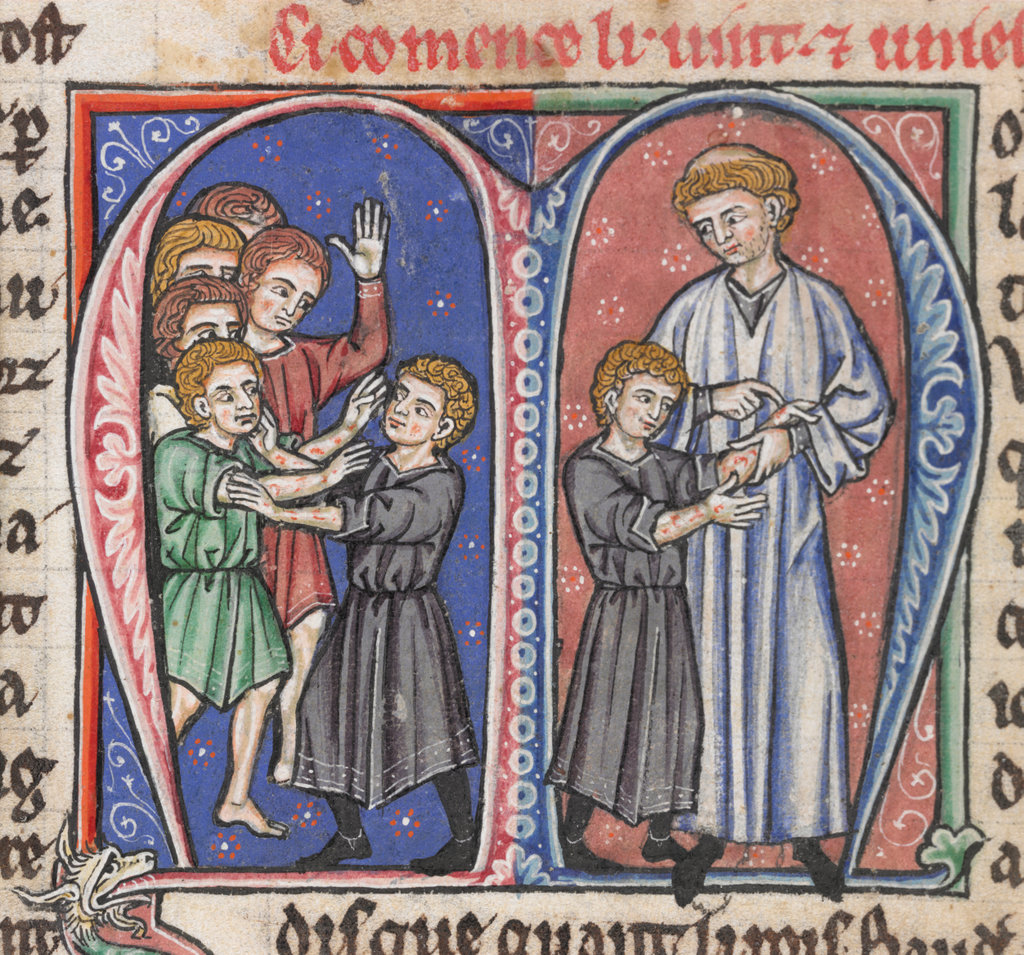
Baldwin’s leprosy is discovered above when he is playing with other children and feels no pain.  Archbishop William of Tyre discovers the illness.  The above painting is included in his writing, Historia


As we did discussed in class, Baldwin IV has been turned into an ideal hero in more recent times.

This is the cover of a book from the 2000s.


This close-up of a painting by Charles-Phillipe Lariviere, done around the 1850s, shows King Baldwin going into battle at Montgisard.  The painting is romanticized to show the king as very healthy and strong.

The Metropolitan Museum of Art’s Crusades Exhibit

First and foremost, check it out for yourself: http://www.metmuseum.org/toah/hd/crus/hd_crus.htm

Image

This site includes interactive maps, themed essays, timelines, historical summaries, and of course pictures of art works.  I think it will be a great resource for our class.  I’m still looking through it, but I wanted to make sure and share it right away.

I’m exploring the site while writing this blog and I keep finding more and more great resources. On the right side, there is a column that lets you search by geographical region and time period and look through a variety of different departments.

I found, for example, this very detailed section about book-making in the Middle Ages which I plan to blog on later: http://www.metmuseum.org/toah/hd/book/hd_book.htm

This whole blog post is mostly because I’m just trying to see if this website works, if I can post pictures successfully, and if hyperlinks will work once I “publish” this post, so I think I’m going to cap it for today and see what happens.

PS does anybody know of a few good websites for basic research?  When you search in google, you mostly just get a lot of Wikipedia results.  I’m looking for good, reliable, informative sites.  Any ideas?